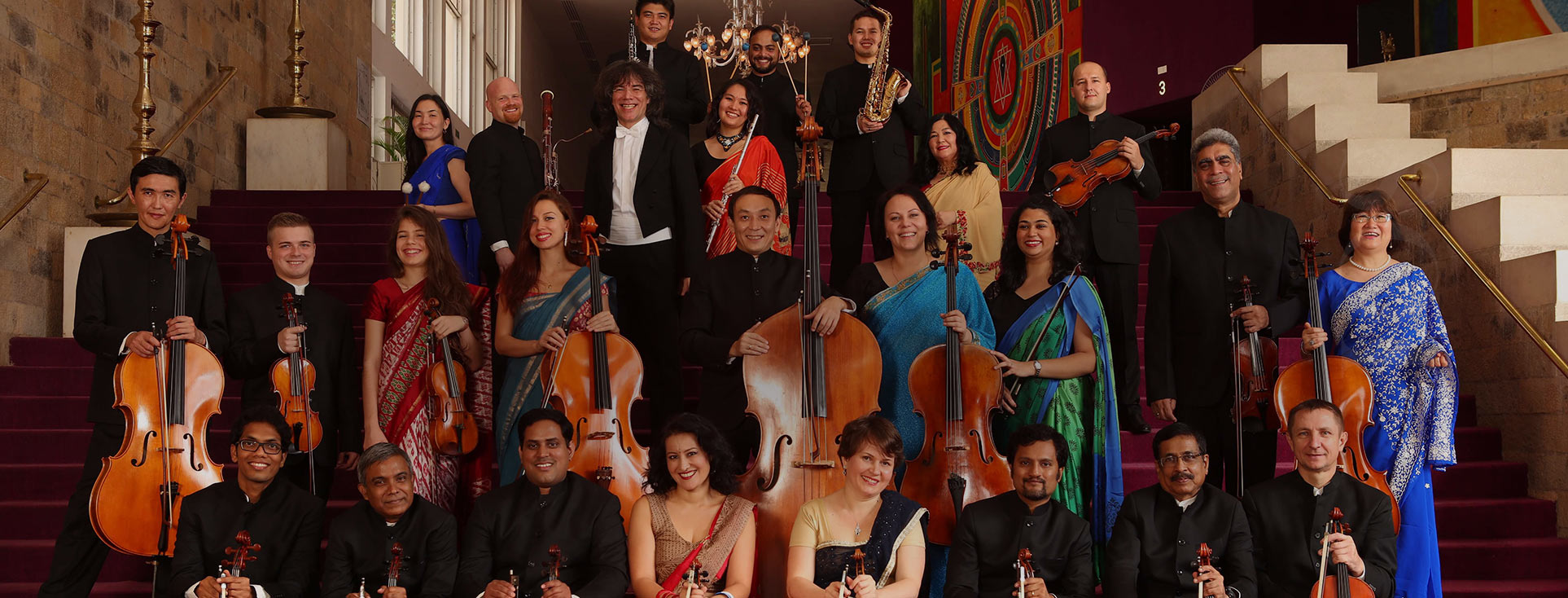
For over 50 years, the Paranjoti Academy Chorus has thrived under the baton of Coomi Nariman Wadia, who moulded the choir into a much loved and revered city institution, while securing for it its rightful place in India and beyond. In honour of her lifelong contribution to choral music, the ensemble returns to the NCPA in a special concert with musicians of the Symphony Orchestra of India, and guest choristers from Chennai, Pune and Colombo, conducted by British maestro and composer Gregory Rose.
By Beverly Pereira

The Paranjoti Academy Chorus (PAC) has always been more than a collective of voices. Formed in Mumbai under the leadership of Dr. Victor Paranjoti in 1960, the ensemble is one of India’s oldest and most distinguished non-denominational choirs with a repertoire that extends from 16th-century music to modern works, encompassing both sacred and secular music. It has carved a niche for itself in India and on international stages through performances of Western choral works, Indian music and repertoire that spans eras and languages. The tradition of choral music, PAC has proved, can be both an inheritance and a living, ever-evolving art. Coomi Nariman Wadia, 93, India’s first female conductor of choral music, is closely tied to the success of the ensemble. In 1967, when entrusted with the baton upon Dr. Paranjoti’s demise, Wadia took on the responsibility of a revered institution with a history that was already in the making. Since then, the choir has kept up its busy performance schedule. From 2023 onwards, Firdause Wadia has served as PAC’s Resident Conductor.
A choral calling
For Padma Shri awardee Coomi Wadia, the tryst with music began at age nine with a second-hand piano gifted to her by a friend of her late father. By the time she was 15, she was singing in school and college choirs and went on to earn diplomas from Trinity College London. Then, in 1961, upon joining the PAC as a soprano, she sang with the ensemble and honed her vocal skills under its founder, Dr. Paranjoti, whose ambition was to establish a serious choral tradition in the country. For years, she lent her voice to the harmony and, oftentimes, was requested by Dr. Paranjoti to step in as conductor, giving her a taste of what the future had in store. In 1967, when she was unanimously appointed as music director and conductor of the choir, Wadia stepped up to her new role with aplomb at a time when female conductors were rare, even in Western countries.
Under Wadia’s leadership, the PAC moved beyond the idea that choral music belonged solely to churches or Western classical traditions. In 1974, the choir took home the first prize for Overall Excellence when it was selected to represent India at the IX International Choral Song Festival in Poland. Soon after, a leading Polish magazine wrote about Wadia: “The director of this young Indian Chorus was Coomi Wadia, whose sensitive, magic hands reduced their gestures to an absolute minimum. This young woman has a very strong artistic will, a suggestive force which holds the choir inescapably gripped by her interpretation.” In 1981, she was selected to conduct the final concert at the Stuttgart Partnersingen Sister Cities Festival comprising over 700 choristers. By the time she was awarded the Padma Shri in 2023. Wadia had led more than 200 concerts worldwide with the PAC. She had even represented India at the 7th World Symposium on Choral Music in 2005 in Kyoto, Japan.
Shaped by the greats, including German conductor and Bach exponent Helmuth Rilling, Wadia has been known to infuse rehearsals with the very passion that informed her own career as a chorister. She has always been clear about the way she wanted the ensemble to sing, effortlessly transforming the human voice into a boundary-pushing instrument of texture and emotion. If there’s a particular musical philosophy that Wadia has returned to at every rehearsal, it is that the choristers must follow the composer and their musical emotion and intention to a tee. At the same time, it’s also about taking the liberty to alter the timing, speed or certain nuances to bring out the best in a music composition. As per committee members of the PAC, “Wadia’s distinction as a choir leader and conductor lies in her deep natural insight into what the composer wants the choir to convey. As Rilling said for her, ‘I see not just technical brilliance in her conducting but a deep intuitive power that guides her to produce marvellous interpretations.’”
A truly Indian choir
Wadia’s influence is evident in the breadth of the repertoire associated with the PAC. Over six decades of its existence, the choir’s recitals have moved effortlessly between Western classical works and Indian compositions in over 22 languages. One of the ensemble’s defining strengths is the presentation of a cappella Indian music set in Western choral form. In fact, Dr. Paranjoti himself wrote and adapted several compositions for the choir, including popular works like ‘Dravidian Dithyramb’. Further, great Indian composers like Vanraj Bhatia wrote pieces in vernacular languages especially for the PAC under Wadia’s leadership. The Six Seasons, with its challenging harmonies and striking word-painting (a composition technique with vocal parts and harmonies that mirror the literal mood of the piece), is but one of them. The choir has also sung ‘Krishna’ stories, which are ever popular.

Today, this meeting of musical traditions remains central to the ensemble’s identity. And, for much of the choir’s history, this identity was lovingly nurtured by Wadia, who helped establish a distinct approach to choral music in a country not traditionally associated with it. Wadia viewed Western repertoire and Indian music traditions as equal partners in a shared musical dialogue. “In India, we have excellent choral music composers in Indian languages whose works deserve to be shared with audiences. There are Western composers of Indian origin writing Indian music too. Although most of us are trained in the Western tradition, we are equally at ease with Indian music. Our strength lies in delivering the nuances that Indian music requires,” say PAC committee members.
The chorus continues
During the three-hour rehearsals that take place every Saturday afternoon, the razor-sharp focus and dedication of a professional choir is evident. Closer to concert dates, the group meets on Saturdays, Sundays and on weekdays after office hours, too, if required. “We book halls for our rehearsals and try to keep the location central by maintaining proximity to major railway stations for the convenience of all choristers. At times, we rehearse in the suburbs too, but currently the Sir J.J. Boys’ School Fort, largely, and the St. Xavier’s Boys Academy at Churchgate, to some extent, are the two hot spots for our rehearsals.” Far from being an institution built solely for professional musicians, the PAC is a collective, sustained by passionate people who manage to make time for rehearsals, often with a day job.
The committee members remark on the PAC’s resonance with generations of singers. “It has always followed the dictum, International Harmony through International Music. This has appealed to both, the young and the old. Also, the choir has always had a familial approach to its functioning, appealing to all generations.” The composition of the choral ensemble has changed over the years, but that does not affect the quality of the renditions. Most choristers range in age from their twenties to their seventies and are either professionals from diverse fields like medicine, law and academics or with corporate backgrounds, making it a challenge to rehearse more than once a week. Thankfully, the advent of technology has led the choir to adapt to the use of digital resources. Today, learning has become easier and more efficient with the gamut of musical information available on websites, ranging from single voices, lines or the entire music with accompaniment.

The ensemble’s passion, dedication and talent will be especially evident at the eagerly awaited recital at the NCPA to honour and celebrate the legacy that Wadia has actively furthered. The PAC will perform with the SOI Chamber Orchestra under the baton of renowned British conductor Gregory Rose for an evening of Bach’s Magnificat, Mozart’s Coronation Mass and Handel’s Zadok the Priest and some unique Indian pieces. Soloists include sopranos Silvija Radjen Kumar and Cathlin Esther, alto Tanisha Herbert, tenor Amar Muchhala and Martin Snell, bass. Choristers from Pune and Chennai and members of The Colombo Philharmonic Choir will also join in.
The concert is an expression of gratitude to Wadia and her lifelong contribution that has shaped not only the ensemble but also the wider field of choral music in India. It is also a beautiful reminder that the Paranjoti Academy Chorus is not simply about preserving a musical legacy, but also about the importance of continuity, experimentation and welcoming newer generations of singers into the fold.
This article was originally published in the September 2026 issue of ON Stage.