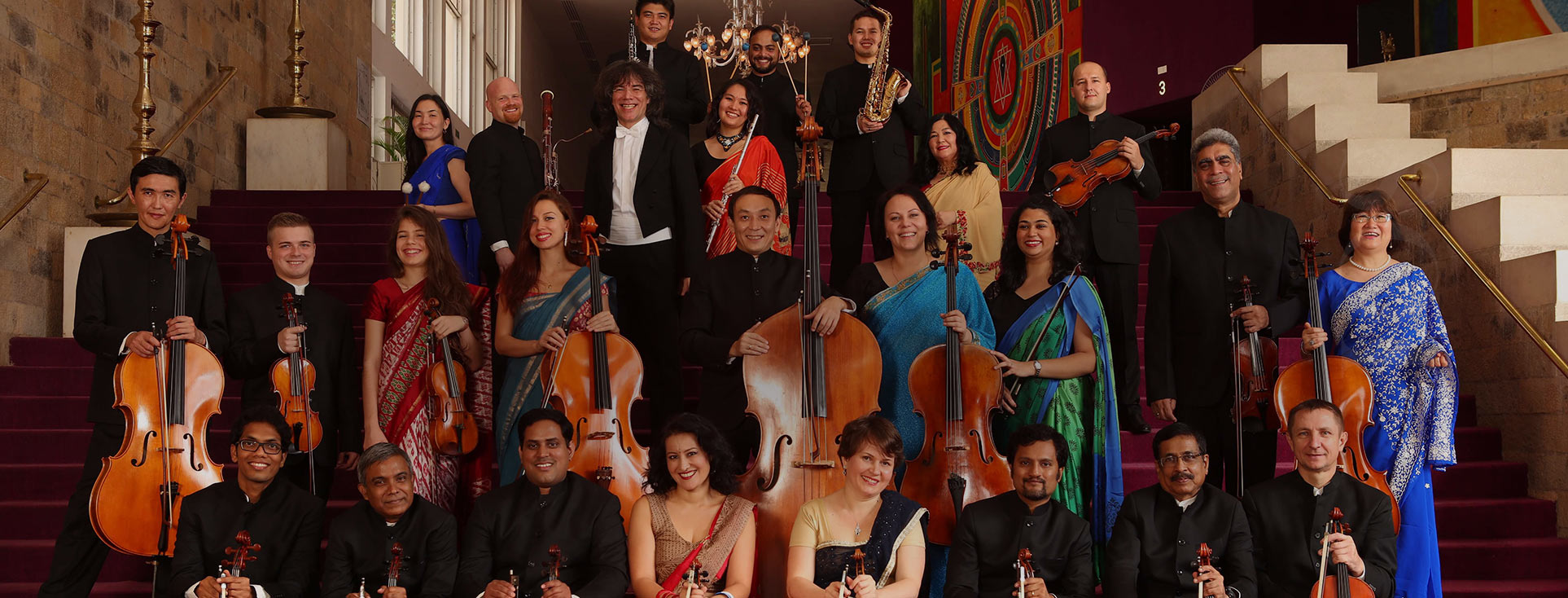
The Absence of PRESENCE by Aditi Mangaldas, in collaboration with the Symphony Orchestra of India, confronts the fracturing of childhoods by war, displacement and loss. Its world premiere this month, brings together Kathak and contemporary dance, with orchestral and Indian classical music, in a powerful multi-genre production.
By Aishwarya Bodke

It was a game I played when I was about six. The sky was the canvas and my fingers tiny paintbrushes that could magically move clouds around. Find shapes, give them names. The only nemesis in sight would be the sun if it decided to gleam a little too harshly on some days. But when a child’s eyes look up at the sky to find warplanes and drones, the option of having a childhood is denied. The world loses a generation of innocence.
There are few things in life that words achingly fail to describe. There are fewer that leave a parched, voiceless void. Images of a six-year-old girl trapped in a car surrounded by the bodies of her dead family members; a young boy being shot while carrying a white flag in hand during an evacuation; corpses the size of a forearm wrapped in white will do just that.
These visuals are not hypothetical. They have been cited in a UN inquiry chaired by Indian jurist Justice S. Muralidhar, documenting Israel’s systematic targeting of Palestinian children with the warning that the damage done may be irreversible. The prolonged devastation since October 2023 has caused a permanent rupture in the human fabric of empathy, as if the world has collectively entered a moral paralysis in the aftermath of an apocalypse. Three Octobers have passed since.
This month, the NCPA will see the world premiere of The Absence of PRESENCE, produced and presented by the Aditi Mangaldas Dance Company and The Drishtikon Dance Foundation, in collaboration with the Symphony Orchestra of India. Commissioned by the NCPA, the work is devoted to the countless childhoods lost to war and to the unfathomable grief of children brutalised, displaced and orphaned around the world.

Mangaldas is at the helm and the heart of the work. “As an artiste, I did not want to simply scroll past these grief-stricken images,” she says, “They stayed with me, day and night, and the torment of witnessing the suffering of innocent children compelled me not to remain silent and to transform it into the language of dance, the only language I know.”
The Absence of PRESENCE traces its origins in an earlier work by Mangaldas, Weeping RED!, created for the fundraising movement ‘Indian Dancers for Gaza’s Children.’ Inspired by Sudeep Sen’s poem ‘Gaza’ and the poetry of Palestinian writer, professor and activist from the Gaza Strip, Refaat Alareer, who was killed during the conflict, the piece became the seed for what has now evolved into a multi-genre production.
Two art forms, one heartbeat
The production marks a rare, first-of-its-kind collaboration between Kathak and the Symphony Orchestra of India, pairing the language of classical dance with the scale and sweep of the country’s only professional symphony orchestra.
Reflecting on the production as the culmination of years of wanting to work together, NCPA Chairman Mr. Khushroo N. Sunook says, “I have always loved one musical tradition, while Aditi has devoted her life to another. But when great artistic traditions meet with integrity, extraordinary things can happen. Bringing together exceptional talent in dance and music to create an original work, and hopefully take it across India and the world, is deeply meaningful. That is precisely what the NCPA aspires to create: works that speak to our own time. History shapes art, but art must respond to the present.”
While the work is spurred by the unimaginable tragedy unfolding in Gaza and the occupied West Bank, Mangaldas shares that it ultimately expands far beyond a single place. It speaks of children everywhere. From the ongoing conflict in Ukraine and the Democratic Republic of Congo to historical atrocities like the Holocaust and the Rwandan genocide. Millions of young lives have been cut short, not by geopolitical violence on the frontiers, but in their homes, schools and playgrounds.
The complete collapse of education and healthcare disrupts the foundations of a wounded society. The psychological burden of surviving settles not only in the memory of a population, but in the land and water, in bloodlines and bloodshed. What is being taken away is not only a childhood but the possibility of the life that should have followed it. How can an artiste then remain silent? Mangaldas repeatedly returns to this question. Artistes must turn to their art and respond with urgency when taking a stand is no longer a luxury.

An excellent creative team propelled by the same provocation stands with Mangaldas. The Absence of PRESENCE brings together multitudes of diverse disciplines. Kathak, contemporary movement, Hindustani classical and orchestral music, an expansive set and sensitive light design all unite with a humanitarian subject at its core.
Dr. Swapnokalpa Dasgupta, Head – Dance Programming, NCPA, notes, “A collaboration of this magnitude, bringing Indian dance into dialogue with orchestral music, with original composition created specifically for the production, has rarely been attempted in India. It is, in every sense, an international production with exceptional collaborators from across the world. It represents an exciting convergence of artistic voices, cultures and disciplines, making this a landmark moment for dance and music in India.”
The herculean task of devising a soundscape for this colossus is in the capable hands of Rushil Ranjan, noted composer and Associate Artist at London’s Royal Albert Hall, whose work is frequently commissioned and performed by leading ensembles, including AR Rahman’s Firdaus Orchestra. Melvin Tay, a frequent collaborator of Ranjan’s, will conduct the ensemble for The Absence of PRESENCE. “I didn’t feel that these traditions needed to be fused into one uniform musical language,” Ranjan tells us, “Each discipline has its own history and expressive power. Trying to smooth out those differences would have been slightly too neat, and probably much less interesting.”
The internal world of the piece follows a uniquely collaborative process wherein music and movement have developed simultaneously over time. On some days, the music came first and on others it responded to the choreography. The intrinsic sounds of Kathak, too, collide with the orchestra in beautiful and haunting ways. At one point, Mangaldas uses nothing but the tapping of feet to evoke the sound of bullets.
Sound and silence
As a composer, Ranjan believes that there are not many palettes wider than the symphony orchestra, fewer still that allow you to capture the complexity of the emotional content the work deals with. The same instruments can express tenderness, rage, fear or hope depending on their register, articulation and the density of the writing. The orchestra is an incredible tool for illuminating those subtleties and allowing conflicting emotions to exist simultaneously.
Bianca Mendonca, General Manager, Symphony Orchestra of India, says, “It is particularly exciting for us to perform music that is being composed by Rushil Ranjan specifically for this creation. There is something about it that reminds us of opera, where the story unfolds onstage while the orchestra is in the pit. We are delighted to perform a work that has been so passionately developed for over a year.”
Mangaldas says it’s her first time working with a symphony orchestra and has been an interesting journey. “It has required us to unlearn some of our conditioning and become receptive to the rich harmonies and emotional tensions. The Kathak body has, almost through osmosis, tried to absorb the landscape of the orchestra.”
A lot of Ranjan’s practice combines diverse musical traditions, but he is less interested in whether his music is labelled Eastern or Western and more invested in ensuring that the emotional truth at its centre is clear. He shares that one of the most challenging parts about this work has been finding a musical language that can begin to describe such harrowing subject matter. Quite often, the most honest answer to that question is silence. There are experiences whose dramatisation is not possible without some risk of trivialising them. “The silence isn’t an absence of expression. It is the silence of contemplation required to comprehend the enormity of the subject. It gives the audience space to encounter what has happened without the music constantly telling them how to feel,” Ranjan explains.\

This idea of absence—of silence and emptiness—runs through the production’s visual grammar. For set designer Manish Kansara, it meant creating a world where absence is to be felt within the architecture itself. Tall, grey, perforated structures define the stage and have a strong physical presence, but one is constantly looking through them. Alongside these large forms, something as small as a child’s shoe indicates that the person who gives it meaning is not around. Kansara avers, “I was interested in what the war takes away, rather than in reproducing a battlefield. The structures can suggest fragments of buildings or an unsettled landscape.”
Ryan Stafford jokes that it would be more accurate to describe his work on this production as a darkness designer as opposed to a lighting designer. Darkness can become a space for uncertainty and loss. Light slips through and behind Kansara’s structures, creating the impression of sunlight searching its way through cracks and rubble. It challenges what the audience gets a glimpse of and what they have to imagine for themselves.
To walk into rehearsal day after day, to inhabit a reality that the rest of the world is growing increasingly numb to, can be exhausting. “It has been heartbreaking, creating this work. We routinely broke down, internalising a pain that we cannot truly understand, only to go back to our relatively safe lives,” confides Mangaldas. In the early stages of the production, she found herself asking: should we donate the money instead of making a production? But as lives are reduced to statistics, an activist must take to the streets, a filmmaker must make films and a dancer must dance in order to resist.
But how does one fight a losing battle? Perhaps ask the children chasing kites through the rubble, turning broken slabs of concrete into slides, learning the violin amid ruins, watching a football match together seconds before being bombed. Perhaps the answer lies in the small, stubborn acts of living. Mangaldas emphasises that loss is universal but hope is the most fundamental impulse of human existence. “I am not foolish enough to think that my art will change their reality, or anything at all,” she adds. “But I trust that it will urge those of us watching to, at the very least, not look away.”
All photos by Adarsh Prathap
This article was originally published in the October 2026 issue of ON Stage.