Santoor exponent and composer Rahul Shivkumar Sharma discusses his approach to classical, folk and symphonic works and what it takes to bridge the gap among genres while keeping the music authentic.
By Narendra Kusnur

In his three-decade-long professional journey, santoor exponent and composer Rahul Sharma has pushed the boundaries on many occasions. Having been trained by his father, the legendary maestro Shivkumar Sharma, he started out with Hindustani classical music but eventually started experimenting with thematic projects. His collaborations with pianist Richard Clayderman, saxophonist Kenny G and the French music duo Deep Forest helped the multistringed santoor cement its place in world music.
For this year’s Aadi Anant festival of Indian music, presented by the NCPA in Mumbai and other cities of India, Sharma will be taking the sound of santoor to Chennai. The Mumbai-based virtuoso player had to think of something new for the inaugural concert of the festival. He thus decided to explore how the santoor can be used in both Hindustani and Carnatic music, with the addition of Kashmiri folk music. The show, titled ‘Kashmir to Kanyakumari’, will be held at the Madras Music Academy on 29th November.
Sharma will be accompanied on the tabla by Ojas Adhiya, ghatam by Giridhar Udupa and keyboards by Avinash Chandrachud. Excerpts from an exclusive interview in which he talks about the forthcoming concert, his training and his journey.
ON Stage: How did the theme of building a bridge between Hindustani and Carnatic music come about?
Rahul Shivkumar Sharma: Hindustani and Carnatic music share their roots in the Vedic times. Both have spiritual origins, ragas and talas, swaras and shrutis. Talking specially of the santoor, there are certain Carnatic ragas that sound beautiful on the instrument. The santoor is capable of complex layakari [which is also an important aspect of Carnatic music]. Keeping that in mind, the idea to showcase this bridge was born.
OS: Some Carnatic ragas like Kirwani, Vachaspati and Charukesi have been adapted to the Hindustani idiom. Will the concert include these ragas or will there be other specially composed works?
RS: The concert will feature a specific Carnatic section with rhythmic improvisations, and then move on to north Indian traditions, particularly folk music from the Jammu and Kashmir region.
OS: What roles will Ojas Adhiya, Giridhar Udupa and Avinash Chandrachud play?
RS: Giridhar will be on the ghatam, accompanying me not only in the Carnatic raga but also accompanying Ojas in the faster composition of the Hindustani raga. Avinash will add a lush atmospheric musical landscape with folksy melodies [on the keyboard], while the tabla and side percussions will be played by Ojas.
OS: Though they have co-existed for years, Hindustani and Carnatic streams have normally attracted different audiences. How far do shows such as yours bring these audiences together?
RS: There will be something for both sets of listeners at this concert. First, the santoor, which is a Kashmiri instrument, will play a complex Carnatic raga, and transport the audience to the ambience of the Dal Lake and shikaras of Kashmir. Whether Carnatic or Hindustani, the roots are ancient and have a spiritual connection with nature. Anybody can experience and appreciate it.
OS: You performed at Aadi Anant 10 years ago with your father in a concert titled ‘Santoor Samvad’. What are your memories of playing with him?
RS: Aadi Anant also has a guru-shishya theme under which my father and I had performed earlier. It signified that learning is limitless or endless, and the journey continues. My very first concert with my father was in 1996 in Norway. That led to the Santoor Viraasat series, where we were accompanied by Ustad Zakir Hussain. My father, of course, is the pioneer of the instrument. He had the vision to bring this instrument out of the valleys into the world of Indian classical music.
OS: How did Shivji balance the roles of father and guru?
RS: Because he was both father and guru, he could spot the fact that I was cut out to be a musician, something I was probably unaware of at that time. I will admit that he was more a father than a guru, and he enjoyed my fusion and symphony work as well. He believed that a disciple should not be a replica of his guru. This approach opens up an entire universe for a young musician. As my guru, he was solely responsible for shaping my classical knowledge and technique, and for giving me the confidence to take his legacy forward. He was proud that the santoor was safe in my hands and also encouraged my endeavours to take it into the world music space.
OS: That brings us to your son Abhinav. What are his musical inclinations?
RS: Abhinav is 12 now. He did begin learning with his grandfather and continues learning from me. He is also busy with cricket and school besides music, but he is aware of his legacy and his roots. Time will tell.
OS: What challenges do young musicians face in learning the instrument?
RS: One has to find the right guru, have patience and not expect to become a star overnight. Once the intricacies of classical music are learnt, a whole new world opens up. Digital learning can help but listening to your own riyaz is very important. One needs to be a dispassionate witness to one’s own talent, ambitions and eventually, destiny.
OS: Talking of your collaborations, how far have your projects with Richard Clayderman, Kenny G and Deep Forest helped the santoor gain recognition in world music?
RS: When I first heard the Greek composer Vangelis, I imagined the santoor in that world. It was my belief that the santoor could lead the way, whether it was with a philharmonic orchestra or in the world of electronica. The response to these collaborations has been terrific. Collectively, the albums Namaste India (with Kenny G), Deep India (with Deep Forest) and Confluence, Vol. 2 (with Clayderman) have generated 10 crore streams on Spotify alone. This itself is huge for instrumental music in India. I have done around 70 albums that include Time Traveller, The Confluence: Santoor & Piano and Ramyug, in which Amitabh Bachchanji sang ‘Jai Hanuman’. They feature classical, fusion, thematic, symphonic and folk music, among other genres.
OS: You have given concerts featuring the santoor and orchestra in Cape Town and Mumbai. How do you approach this genre, considering it is vastly different from Indian classical performance?
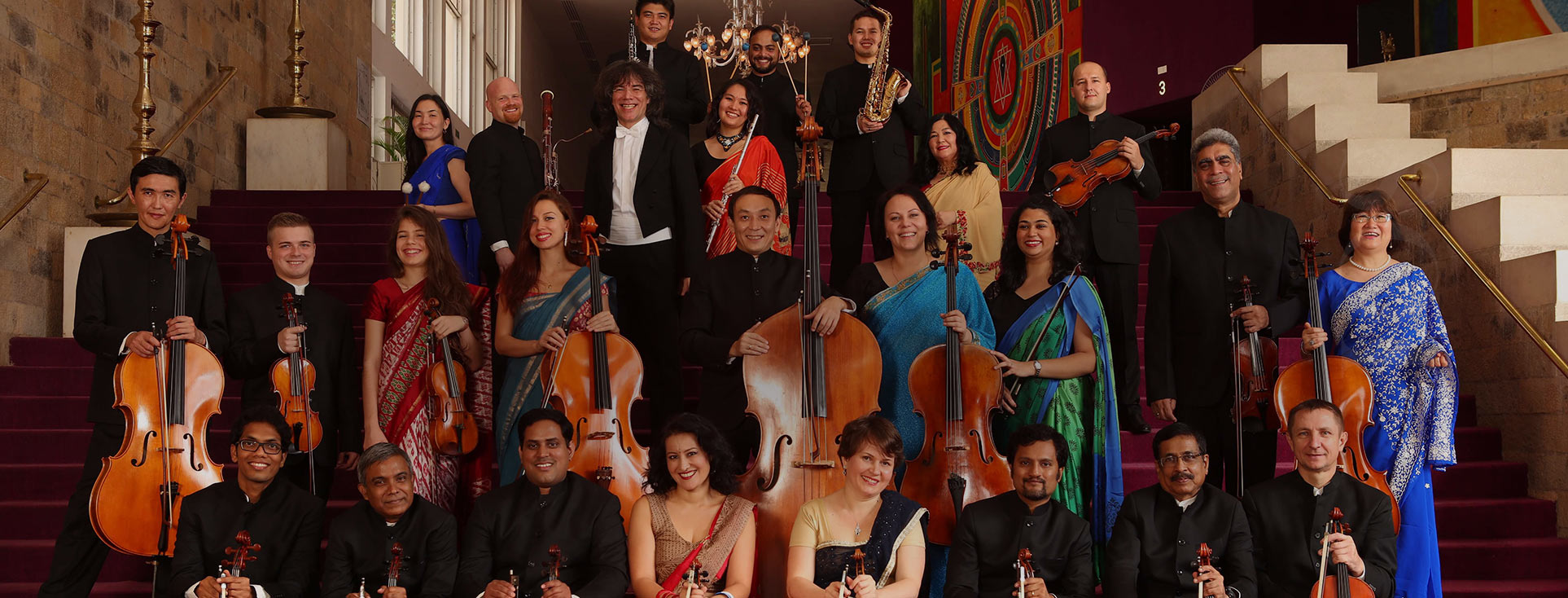
RS: It is a completely different approach indeed. Indian classical is about improvisation and requires a lot of patience to bring out the alaap. Thereafter, it requires imagination once one immerses in a raga. A symphony is like taking the santoor into the world of Beethoven and Mozart, and composing the work with the sophistication required to meet a philharmonic orchestral sound. It is the composer’s imagination that can refine the music, include ragamalas, incorporate jazz and folk elements, and provide the audience a novel experience with the 35-member orchestra led by the santoor.
OS: What new projects are you working on?
RS: My latest album is Ananda: The Cosmic Bliss, a collaboration with Ricky Kej and Turkish qanun maestro Ahmet Baran. There are also some solo concert tours across North America lined up, and more albums with international artistes.
OS: While performing traditional Indian classical music, do you still feel the pressure of being compared with Shivji?
RS: Each time I’m playing Indian classical concerts, it’s with a certain reverence to my guru. It is natural for people to make comparisons. And why not? I’m his son and the torchbearer of his legacy. It is a matter of pride that I am carrying it forward.
This article was originally published in the November 2026 issue of ON Stage.